Adoption was an attention problem
Redesigning the environment, not the feature
Company: CallRail
Year: 2024
Role: Product Designer
During a live call, agents are listening, responding, and trying to tag the interaction at the same time. Tags connect to reports, filters, notifications, and the call log across the platform -- so for the agents who relied on them, getting it right in the moment mattered.
Tagging had a 13% adoption rate. The feature wasn't hard to find. It was hard to use at the exact moment it was needed.
The problem
Tagging lived in a supporting panel -- a separate surface that pulled attention away from the active call. On smaller browser windows, it disappeared entirely. The option to tag was not just inconvenient. It was sometimes gone.
Research confirmed something simpler than expected. Agents weren't skipping tags because they didn't care. They were skipping them because the moment passed. By the time the call ended and attention was free, the context was already gone.
The feature wasn't the problem. Where it lived was.
the reframe
The instinct was to make the feature more visible. But agents who needed to tag weren't failing to find it -- they were failing to use it during the call, when attention was already fully occupied.
The problem wasn't discoverability. It was the environment.
What I designed
Classification moved into the main panel -- where the call was already happening. No navigation, no mode switch, no attention shift.
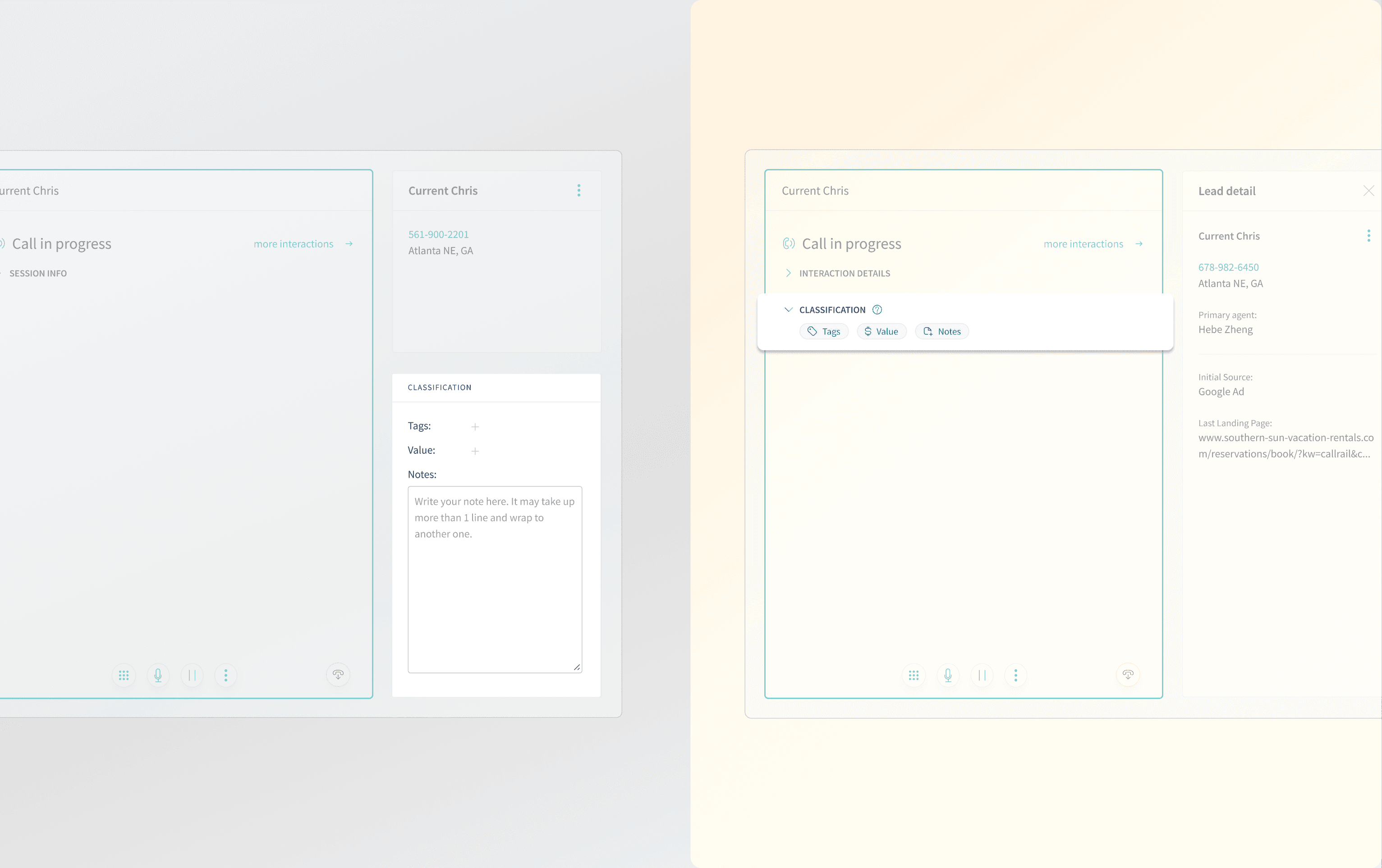
Tags, value, and notes became individual actions. Clicking any one of them opened directly in the panel. For tags, a popover showed all available options as colored pills -- faster to scan, less to think about mid-call.
The classification section stayed visible during every call but could be collapsed when agents needed more workspace. It never disappeared on them.
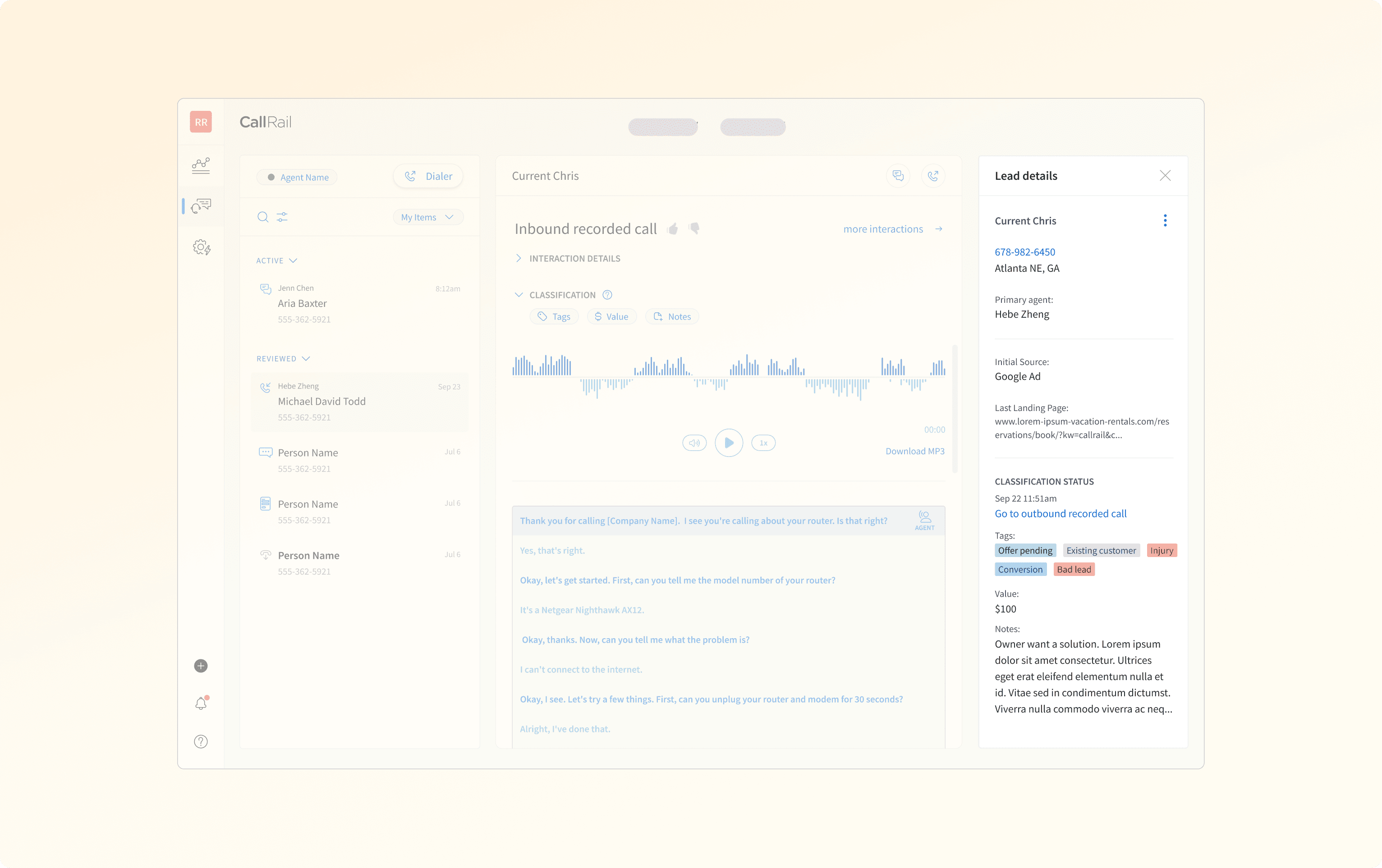
The supporting panel that classification vacated became something more useful: a context surface. When a caller rang back, agents could see the most recent tag, value, and notes from the previous interaction without leaving the call.
what didn't shipped and why
Three options came before the one we shipped.
The first kept the design system's instinct: all three fields expanded at once, a full form. Consistent on paper. But opening it mid-call added weight at the worst moment, and blocked part of the panel.
The second was a disclosure model -- open a dropdown, choose a feature, complete it, repeat. Adding a tag meant a nested dropdown inside that, two extra clicks per classification. Structured on paper. Exhausting in practice.
The third was closest to what shipped. Individual actions, independently accessible -- the right instinct. But the plus icons ate up vertical space and pushed the call out of view.
Each option solved for structure. None of them solved for the moment the agent was actually in. A pattern that works in a reflective context doesn't automatically work in a real-time one.

what changed
Tagging adoption rose from 12.5% to 15.45% in the first month -- a 24% lift. Months two and three held between 25 and 30%. This was not a novelty spike. It was a sustained behavioral change.
Measured via Fullstory -- click rates and pill interactions. No other product changes happened in that window, so attribution is clean.
The reframe mattered more than the number. This was not a feature adoption problem. It was a cognitive environment problem. Redesign the environment, and behavior follows.
During a live call, agents are listening, responding, and trying to tag the interaction at the same time. Tags connect to reports, filters, notifications, and the call log across the platform -- so for the agents who relied on them, getting it right in the moment mattered.
Tagging had a 13% adoption rate. The feature wasn't hard to find. It was hard to use at the exact moment it was needed.
The problem
Tagging lived in a supporting panel -- a separate surface that pulled attention away from the active call. On smaller browser windows, it disappeared entirely. The option to tag was not just inconvenient. It was sometimes gone.
Research confirmed something simpler than expected. Agents weren't skipping tags because they didn't care. They were skipping them because the moment passed. By the time the call ended and attention was free, the context was already gone.
The feature wasn't the problem. Where it lived was.
the reframe
The instinct was to make the feature more visible. But agents who needed to tag weren't failing to find it -- they were failing to use it during the call, when attention was already fully occupied.
The problem wasn't discoverability. It was the environment.
What I designed
Classification moved into the main panel -- where the call was already happening. No navigation, no mode switch, no attention shift.
Tags, value, and notes became individual actions. Clicking any one of them opened directly in the panel. For tags, a popover showed all available options as colored pills -- faster to scan, less to think about mid-call.
The classification section stayed visible during every call but could be collapsed when agents needed more workspace. It never disappeared on them.
The supporting panel that classification vacated became something more useful: a context surface. When a caller rang back, agents could see the most recent tag, value, and notes from the previous interaction without leaving the call.
what didn't shipped and why
Three options came before the one we shipped.
The first kept the design system's instinct: all three fields expanded at once, a full form. Consistent on paper. But opening it mid-call added weight at the worst moment, and blocked part of the panel.
The second was a disclosure model -- open a dropdown, choose a feature, complete it, repeat. Adding a tag meant a nested dropdown inside that, two extra clicks per classification. Structured on paper. Exhausting in practice.
The third was closest to what shipped. Individual actions, independently accessible -- the right instinct. But the plus icons ate up vertical space and pushed the call out of view.
Each option solved for structure. None of them solved for the moment the agent was actually in. A pattern that works in a reflective context doesn't automatically work in a real-time one.
what changed
Tagging adoption rose from 12.5% to 15.45% in the first month -- a 24% lift. Months two and three held between 25 and 30%. This was not a novelty spike. It was a sustained behavioral change.
Measured via Fullstory -- click rates and pill interactions. No other product changes happened in that window, so attribution is clean.
The reframe mattered more than the number. This was not a feature adoption problem. It was a cognitive environment problem. Redesign the environment, and behavior follows.
During a live call, agents are listening, responding, and trying to tag the interaction at the same time. Tags connect to reports, filters, notifications, and the call log across the platform -- so for the agents who relied on them, getting it right in the moment mattered.
Tagging had a 13% adoption rate. The feature wasn't hard to find. It was hard to use at the exact moment it was needed.
The problem
Tagging lived in a supporting panel -- a separate surface that pulled attention away from the active call. On smaller browser windows, it disappeared entirely. The option to tag was not just inconvenient. It was sometimes gone.
Research confirmed something simpler than expected. Agents weren't skipping tags because they didn't care. They were skipping them because the moment passed. By the time the call ended and attention was free, the context was already gone.
The feature wasn't the problem. Where it lived was.
the reframe
The instinct was to make the feature more visible. But agents who needed to tag weren't failing to find it -- they were failing to use it during the call, when attention was already fully occupied.
The problem wasn't discoverability. It was the environment.
What I designed
Classification moved into the main panel -- where the call was already happening. No navigation, no mode switch, no attention shift.
Tags, value, and notes became individual actions. Clicking any one of them opened directly in the panel. For tags, a popover showed all available options as colored pills -- faster to scan, less to think about mid-call.
The classification section stayed visible during every call but could be collapsed when agents needed more workspace. It never disappeared on them.
The supporting panel that classification vacated became something more useful: a context surface. When a caller rang back, agents could see the most recent tag, value, and notes from the previous interaction without leaving the call.
what didn't shipped and why
Three options came before the one we shipped.
The first kept the design system's instinct: all three fields expanded at once, a full form. Consistent on paper. But opening it mid-call added weight at the worst moment, and blocked part of the panel.
The second was a disclosure model -- open a dropdown, choose a feature, complete it, repeat. Adding a tag meant a nested dropdown inside that, two extra clicks per classification. Structured on paper. Exhausting in practice.
The third was closest to what shipped. Individual actions, independently accessible -- the right instinct. But the plus icons ate up vertical space and pushed the call out of view.
Each option solved for structure. None of them solved for the moment the agent was actually in. A pattern that works in a reflective context doesn't automatically work in a real-time one.
what changed
Tagging adoption rose from 12.5% to 15.45% in the first month -- a 24% lift. Months two and three held between 25 and 30%. This was not a novelty spike. It was a sustained behavioral change.
Measured via Fullstory -- click rates and pill interactions. No other product changes happened in that window, so attribution is clean.
The reframe mattered more than the number. This was not a feature adoption problem. It was a cognitive environment problem. Redesign the environment, and behavior follows.